GEO prompts: get cited by ChatGPT & Perplexity.
10 copy-paste tests that show whether AI engines cite your site — and the honest evidence on what actually moves citations. No myths, no guru claims. Free.
By GorillaSEO · October 2026 · 11 min read
The short version
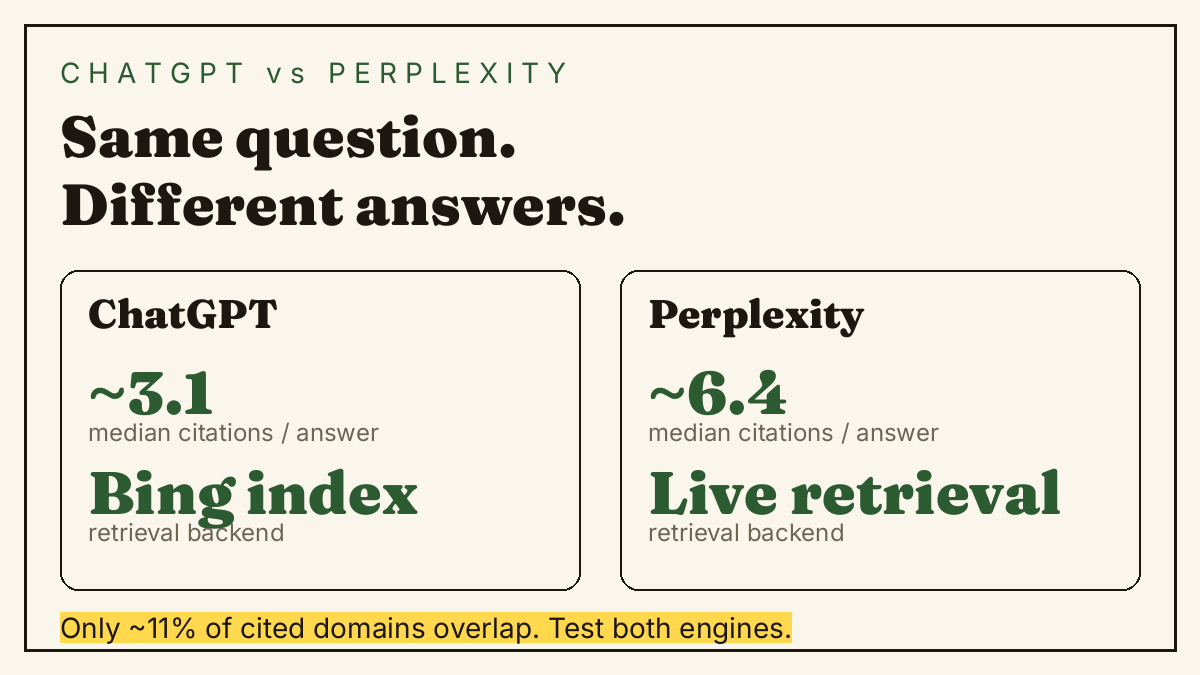
Everyone sells “generative engine optimization” guides. Almost none give you the actual prompts to test whether it works — and most repeat claims the evidence doesn’t support. These 10 prompts test your AI citation reality on ChatGPT and Perplexity in about 30 minutes. One warning first: ChatGPT and Perplexity share only ~11% of cited domains. There is no single “GEO strategy” — you have to test each engine separately.
How to use these (3 minutes)
Run prompts 1–5 on ChatGPT (with browsing on) and prompts 6–8 on Perplexity. Run each prompt 2–3 times — citations vary between runs, so average the results. Log which domains get cited in a simple sheet. Prompts 9–10 check your technical setup. Don’t trust a single run; AI citations are volatile.
01 · The entity test (ChatGPT)
Tests: whether ChatGPT even knows your brand exists — the absolute baseline.
Run on: ChatGPT, fresh chat, browsing on.
What is [YOUR BRAND NAME]? What does it do, and where can I find its work?

[Replace with your exact brand name. Run 3 times. Note: does it describe you correctly, confuse you with someone else, or say it doesn't know you?]
02 · The unprompted recommendation (ChatGPT)
Tests: whether ChatGPT recommends you without being asked — the query that maps to revenue.
Run on: ChatGPT, fresh chat.
Who should I hire for [YOUR SERVICE] in [YOUR CITY/AREA]?

[Example: "Who should I hire for SEO in Ghaziabad?" Run 3 times. Log every brand cited. Are you on the list? Who beats you?]
03 · The best-X list test (ChatGPT)
Tests: listicle presence — studies report ~44% of ChatGPT-cited pages are "best X" lists.
Run on: ChatGPT, fresh chat.
What are the best [YOUR CATEGORY] options right now?

[Example: "What are the best SEO agencies for local businesses in India?" Note which listicles get cited — then check: are YOU featured in any of those lists? That's your fastest win.]
04 · The comparison test (ChatGPT)
Tests: whether ChatGPT has enough material to represent you fairly against a competitor.
Run on: ChatGPT, fresh chat.
Compare [YOUR BRAND] with [NAMED COMPETITOR]. Which is better for [SPECIFIC NEED]?

[If it can't compare you, or invents facts about you, your entity footprint is too thin. Note every invented claim — that's what prospects see.]
05 · The freshness test (ChatGPT)
Tests: whether your content is current enough — studies report 76–90% of cited pages were recently updated.
Run on: ChatGPT, fresh chat.
Is [A SPECIFIC CLAIM FROM YOUR SITE] still accurate as of today?

[Pick a claim with a date or number, e.g. pricing. If it quotes outdated info, your page needs a refresh with a visible updated date.]
06 · The entity test (Perplexity)
Tests: the same baseline as prompt 01 — but Perplexity retrieves live, so results often differ completely.
Run on: Perplexity, new thread.
What is [YOUR BRAND NAME]? What does it do?

[Compare with prompt 01's answers. Different sources cited? That's normal — the two engines share only ~11% of cited domains. You need both.]
07 · The live-answer test (Perplexity)
Tests: Perplexity's live retrieval — it favors fresh, community, and primary sources over encyclopedic ones.
Run on: Perplexity, new thread.
What is the best approach for [YOUR AUDIENCE'S COMMON QUESTION] in 2026?

[Example: "What is the best approach for local SEO for a new business in 2026?" Perplexity cites a median of ~6 sources per answer vs ChatGPT's ~3 — more slots, more chances. Log all cited domains.]
08 · The question-heading test (Perplexity)
Tests: whether your pages are structured to be quoted — question-based headers get extracted most.
Run on: Perplexity, new thread.
[PASTE ONE PAGE'S MAIN CONTENT, TEXT ONLY]

If someone asked "[THE QUESTION THIS PAGE ANSWERS]", which exact sentences from this text would you quote? What would you have to look up elsewhere?

[Whatever it "looks up elsewhere" is your content gap. Add it to the page under a question-based heading.]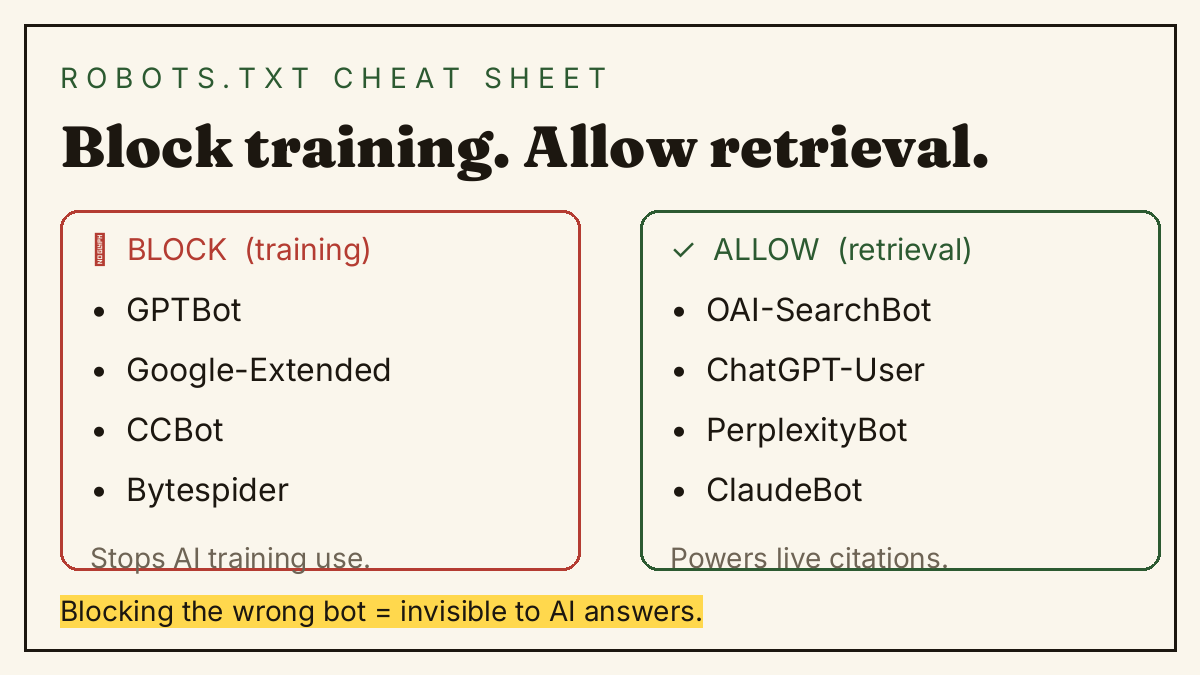
09 · The crawler audit
Tests: whether your robots.txt blocks the wrong AI bots — the most common technical GEO mistake.
Run on: any AI chat.
Here is my robots.txt:

[PASTE ROBOTS.TXT]

Which AI crawler user-agents does this block or allow? Specifically: am I blocking OAI-SearchBot, ChatGPT-User, PerplexityBot, or ClaudeBot (the retrieval bots that power live citations)? Am I blocking GPTBot or Google-Extended (training bots — blocking those is fine and doesn't hurt citations)? Give me the corrected robots.txt.
10 · The citation tracker setup
Tests: nothing directly — it builds your ongoing measurement system.
Run on: any AI chat.
I want to track my AI citation share weekly. My business: [WHAT YOU DO], audience: [WHO], area: [WHERE].

Build me a table of 20 prompts my real customers would ask (mix: "best X", "how do I", "X vs Y", pricing questions). For each: which engine to run it on (ChatGPT/Perplexity), and columns to log: date, run 1 citations, run 2 citations, my brand cited? (y/n). Include a scoring rule: brand cited in 2+ runs = 1 point.
What the evidence actually says
Most GEO guides recycle the same advice. Here’s what published research and large-scale studies actually report — with the caveats the guides skip:
- The Princeton paper is real, but read it carefully. Aggarwal et al.’s “GEO: Generative Engine Optimization” (arXiv:2311.09735, KDD 2024) found up to 40% visibility lift from tactics like citing sources, adding quotations, and including statistics (30–40% band). But it was tested on a custom-built engine, not production ChatGPT or Perplexity.
- A 2026 replication on 3,205 real pages tells a harder story. Statistics density replicated on all four production platforms — but citation and quotation density went the wrong direction. Hypothesis: engines cite primary sources, not pages that merely aggregate citations. (Source: AI+Automation, March 2026 data.)
- ChatGPT ≠ Perplexity. Test both. Studies report the two share only ~11% of cited domains. ChatGPT retrieves largely via the Bing index (only ~30% of its citations come from Google’s top-10); Perplexity uses live retrieval (~89% from Google’s top-10). One “GEO strategy” is provably wrong.
- Freshness beats almost everything. 76–90% of cited pages were recently updated. Word count correlates ~zero with citations. Schema markup showed ~zero measurable citation impact in Ahrefs’ large-scale analysis.
- “Best X” lists dominate ChatGPT citations — ~44% of cited page types in one large study. If your category has listicles and you’re not on them, that’s the gap.
- India-specific: a 2026 India study found Gemini cites 90% of English answers but only 41.3% of Hinglish ones. If your audience searches in Hinglish, English-first content gets cited more.
Where most GEO guides lie to you
- “Add llms.txt and AI will cite you.” llms.txt is a real proposal (Jeremy Howard, Sept 2024), but Ahrefs found 97% of sites with llms.txt received zero bot requests for the file, and Google ignores it. Cheap to add; don’t expect citations from it.
- “Block GPTBot to protect yourself.” Blocking GPTBot stops OpenAI training use — it doesn’t affect citations at all. Live citations come from OAI-SearchBot and ChatGPT-User. Block training bots, allow retrieval bots (prompt 09 checks this).
- “Schema markup boosts AI citations.” Large-scale data shows ~zero measurable impact. Schema is still good practice for search — just don’t expect it to move AI citations.
- “Rank #1 on Google = AI citations.” Only ~30% of ChatGPT citations come from Google’s top-10, and over a quarter of its most-cited pages have zero Google visibility. Rankings help; they’re not the gate.
- Fake-precise statistics. If a guide gives you an exact table (“quotations +41.2%”), be suspicious — secondary sources conflict on the Princeton paper’s per-method numbers. The paper itself reports 30–40% bands. Anyone more precise than the paper is inventing precision.
Use AI for the mechanical 70%. Keep the judgment 30% human — that’s the part clients actually pay for.
Want the human version?
Run these prompts — they genuinely show where you stand. And when you want someone to close the gaps: our AI search optimization service covers entity setup, citation tracking, and the technical fixes above. Start with a free technical SEO audit — 30 points, screen-recorded, findings yours to keep.
Asked, answered.
How do I check if ChatGPT or Perplexity is citing my website?
Run a fixed set of 10–20 real user prompts weekly on each engine, log which domains get cited, and average 2–3 runs per prompt since citations vary run to run. Supplement with Bing Webmaster Tools (for Copilot citations), GA4 AI-referrer segments, and server logs showing AI crawler user-agents.
Why does Perplexity cite my site but ChatGPT doesn’t (or vice versa)?
They retrieve from different backends — ChatGPT largely via the Bing index, Perplexity via its own live retrieval — and studies find they share only about 11% of cited domains. ChatGPT favors established, encyclopedic sources; Perplexity favors fresh, community, and primary sources. Check your Bing indexation first if ChatGPT ignores you.
Does adding llms.txt help AI engines cite me?
llms.txt is a real proposal (Jeremy Howard, September 2024) with modest adoption among docs sites, but Ahrefs found 97% of sites with llms.txt received zero bot requests for the file, and Google has said it ignores it. It’s cheap to add but don’t expect citations from it.
Should I block GPTBot in robots.txt?
Blocking GPTBot stops OpenAI from using your content for model training — it does not affect citations, because live ChatGPT citations come from OAI-SearchBot and ChatGPT-User. The sensible playbook: block training crawlers, explicitly allow retrieval crawlers.
How long does GEO take to show results?
Retrieval-based citations can shift within weeks of restructuring content or fixing indexation; brand-level presence (Wikipedia mentions, editorial reviews, training data) takes quarters. Track trajectory over time, not snapshots, because citations are volatile between runs.
Does ranking #1 on Google guarantee an AI citation?
No. Only about 30% of ChatGPT’s citations come from Google’s top-10 results (versus ~93% for Google AI Mode), and over a quarter of ChatGPT’s most-cited pages have zero Google organic visibility. Rankings help, but they are not the gate — especially for ChatGPT.